The Problem
Half a day of copy-paste
Creating a client proposal takes half a day and is mostly copy-paste from the last one. Slow proposals mean slower closes — the longer it takes to get a document in front of a client, the more time competitors have to get there first.
How It Works
One form, one linear pipeline
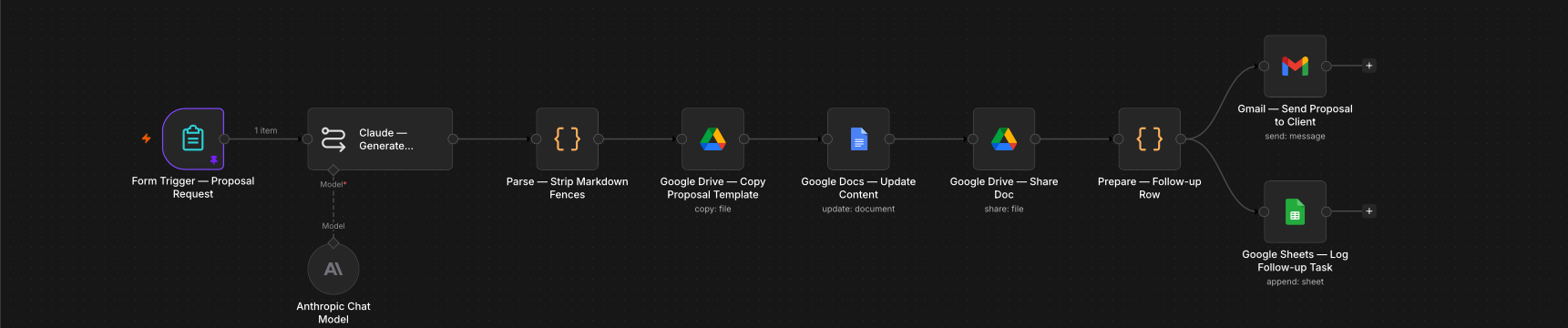
One submission is one item flowing straight through — no branching, no item-count risk.
Rep submits the brief
A short form collects client name, client email, service, scope notes, and optional budget & timeline.
Claude writes the proposal
Generates a 350–450 word proposal body as plain text — overview, scope, timeline, pricing approach, next steps — deliberately no markdown, since it's headed straight into a Google Doc.
Clean and package
Strips any accidental code-fence wrapping from the AI output and repackages the form fields, AI text, and today's date into one clean object.
Clone the template
Duplicates a pre-built Google Doc template into a new file named "{Client Name} — Proposal".
Fill in the placeholders
Three find-and-replace passes swap in the real client name, date, and AI-generated body.
Share, send, and log the follow-up
Sets the doc to link-viewable, then fans out to two independent branches: emails the client the doc directly, and appends a row to the Proposals Log — that row is the follow-up task, serving as a lightweight CRM.
The result: proposal creation drops from 3–4 hours to under 5 minutes. The client gets a professional, tailored proposal while the conversation is still warm, and every sent proposal automatically creates its own follow-up reminder — nothing waits on a reply that never gets chased.
Tech Stack